NEWS
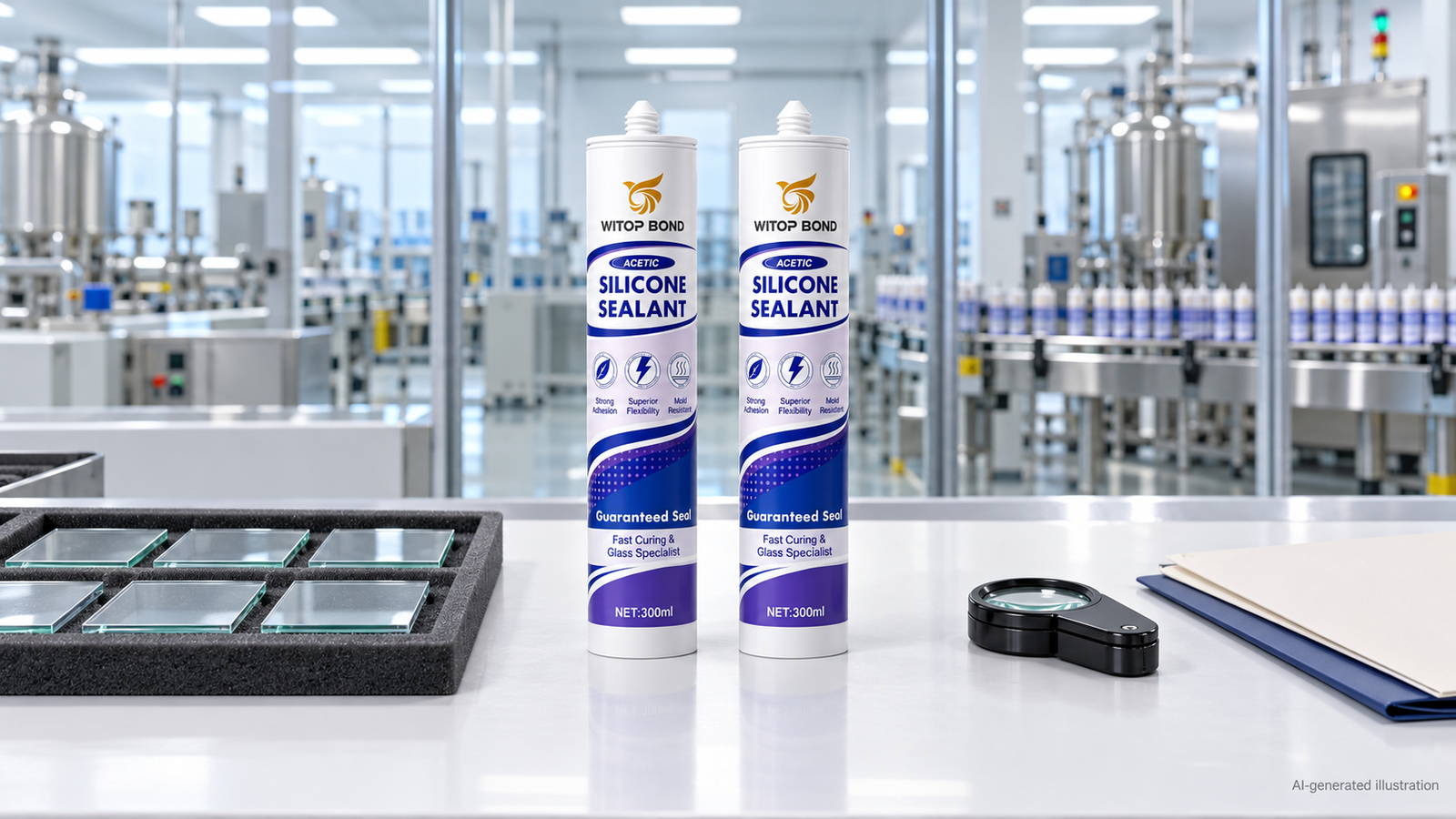
Acetic Silicone and Aquarium Use: A Buyer's Evidence Checklist
A customer asking for aquarium silicone is not simply asking for a clear glass sealant. For an importer or distributor, the first task is to establish whether the proposed product is expressly intended for the requested use. The following questions help organize that decision. They do not claim that a general WITOP BOND Acetic Silicone Sealant is an aquarium-approved grade.
Does vinegar cure mean aquarium safe?
No. Vinegar cure describes acetic or acetoxy curing chemistry, not approval for a particular assembly. A clear appearance, familiar smell or waterproof description cannot establish suitability for continuous contact with aquarium water or for the load-bearing joints of a tank.
The distinction is visible in manufacturers’ own documentation. Sika’s Sikasil GP-101 sheet identifies a general-purpose acetoxy silicone but excludes aquarium use. Soudal’s Silirub AQ sheet expressly identifies all-glass aquarium construction and repair among its applications. These are examples of different product scopes, not approvals transferable to WITOP BOND. Sika: Sikasil GP-101 Product Data Sheet; Soudal: Silirub AQ Technical Datasheet.
What exactly is the customer asking the sealant to do?
Separate new tank construction, repair of an existing glass joint and attachment of an internal accessory. Do not treat these as one interchangeable use. Record the tank materials, intended water exposure, dimensions and the responsible fabricator or repair professional.
Send those details to the proposed supplier for review. If the tank includes plastics, coatings or an unknown existing sealant, identify them rather than describing the entire assembly only as glass. Where a repair affects the tank’s integrity, obtain an appropriate technical assessment instead of recommending an extra bead from a product photograph.
Which documents should match the cartridge?
Ask for the exact manufacturer, grade and product code, together with current TDS and SDS documents. Check that the names and revisions correspond to the quoted product. A sheet for a similarly named grade or another brand does not close the inquiry.
Request written confirmation covering the intended aquarium use and any stated limits. Ask what supporting evidence is available, what it evaluates and which formulation it identifies. Keep handling information, application suitability and assembly design approval as separate questions. An SDS is important for handling; it is not, by itself, a complete aquarium-construction approval.
How should additive and safety claims be evaluated?
Do not infer aquarium suitability from sanitary, anti-mold or general sealing language. Ask the manufacturer to confirm that the complete formulation is suitable for the intended aquarium exposure, including any relevant additive restrictions. Avoid reducing this review to a single label phrase.
For example, the Silirub AQ datasheet makes an explicit statement about its suitability for organisms and absence of relevant toxic additives such as fungicides. That is information about that named product only. A supplier proposing another grade must provide its own documented position; copying the wording would not supply the missing evidence.
What should a sample evaluation establish?
Agree the evaluation with the supplier and responsible aquarium fabricator before opening samples. Record the product and batch, representative materials, preparation method, proposed joint configuration, conditioning requirements and acceptance decision. Ask who is qualified to approve each part.
Keep sample observations within their scope. A small adhesion demonstration does not validate a tank’s design, long-term immersion performance or suitability for aquatic life. Do not use live animals as an improvised product test. A successful visual check should not be relabeled as laboratory certification.
When is it appropriate to proceed?
Proceed only when the selected grade’s documented scope and the intended assembly requirements align. Follow that grade’s preparation, curing and commissioning instructions. Do not borrow a waiting period from another brand or use the disappearance of odor as the release criterion.
If information is missing, keep the quotation conditional and state the unresolved item clearly. For repeat orders, preserve the approved product identity and require review of substitutions. A change of formulation or application should not inherit the previous decision automatically.
What should buyers send to WITOP BOND?
WITOP BOND manufactures and supplies adhesives and sealants with global shipping. For an Acetic Silicone Sealant inquiry, share the intended task, materials, exposure, destination and estimated quantity. Ask us to confirm whether a suitable grade and supporting documents are available before specifying aquarium use.
Technical note: This is a document-review checklist, not tank-design advice or a statement of WITOP BOND aquarium certification. No product-specific strength, cure time or aquatic-safety result is claimed.