NEWS
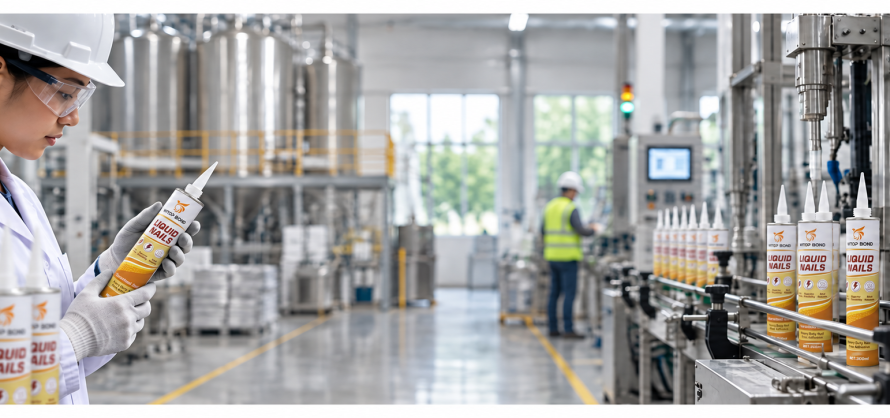
Liquid Nail-Type Construction Adhesives: Global Buyer Questions Answered
Construction adhesives are increasingly used for wall panels, mouldings, furniture, flooring components and general building installation. Global buyers are paying particular attention to instant grab, no nails installation, heavy duty performance and whether the total solution is cost effective.
Q1: What is a liquid nail-type construction adhesive?
It is a cartridge-packed adhesive intended to bond building and decorative materials without relying entirely on visible nails or screws.
Depending on the formulation, it may be water-based, solvent-based, polyurethane, hybrid polymer or another polymer system. Different technologies have different curing mechanisms, odors, flexibility and material compatibility.
Q2: Does “instant grab” mean instant full strength?
No. Instant grab refers to initial holding power immediately after two surfaces are pressed together. Final strength normally develops during curing.
Heavy or overhead materials may still require temporary bracing. Buyers should compare initial grab, open time, repositioning time and final curing time instead of treating them as the same measurement.
Q3: Does “no nails” mean mechanical fasteners are never required?
Not necessarily. No nails describes applications where adhesive can reduce or eliminate visible fasteners. It does not mean adhesive should replace structural anchors in every situation.
Load-bearing, safety-critical, overhead and exterior installations may require mechanical fasteners in addition to adhesive. Even construction-adhesive manufacturers sometimes recommend using adhesive alongside nails or screws for demanding projects.
Q4: What does “heavy duty” actually mean?
Heavy duty is a performance description, not a universal strength rating. Results depend on:
- Bonded materials
- Surface preparation
- Adhesive thickness
- Temperature and humidity
- Curing time
- Static or moving load
- Interior or exterior exposure
Ask suppliers for a Technical Data Sheet and test method rather than relying only on front-label claims. For example, ASTM C557 applies specifically to adhesives fastening gypsum wallboard to wood framing and includes strength, gap-filling, freeze-thaw and aging tests. It does not certify every possible application.
Q5: Can one adhesive bond every material?
No single formulation is ideal for every substrate. Wood, concrete, ceramic, metal, PVC, foam and plastics have different surface characteristics.
Polyethylene and polypropylene can be particularly difficult to bond without specialized surface treatment or adhesive technology. Buyers should provide actual substrate samples and request compatibility testing before bulk orders.
Q6: Why are low-VOC products receiving more attention?
Indoor air quality has become an important purchasing consideration, particularly for homes, schools, hospitals and occupied commercial spaces.
The US EPA notes that some conventional solvent-based construction adhesives can emit substantial VOCs and recommends selecting the lowest-VOC product suitable for the application. VOC content and VOC emissions are related but not identical, so buyers should confirm which test or certification supports a claim. US EPA guidance
Certifications such as UL GREENGUARD evaluate chemical emissions, with GREENGUARD Gold applying stricter limits for sensitive indoor environments. Certification should be verified for the exact product, not assumed from the formulation category. UL GREENGUARD
Q7: Are polyurethane and hybrid polymer adhesives the same?
No. Polyurethane, MS polymer, polyether, silicone and water-based acrylic systems use different chemistry.
Polyurethane products can provide strong bonding but may involve diisocyanate-related safety requirements. In the European Union, certain professional and industrial uses of products containing regulated concentrations of diisocyanates require training and supply-chain information. Buyers should review the exact formulation and destination-country requirements.
Q8: Can construction adhesive be used in hot, cold or humid conditions?
Performance varies by formulation. Low temperature can slow curing or make extrusion difficult, while very dry conditions may affect moisture-curing systems. High humidity may accelerate some products but negatively affect others.
“All-weather” should therefore be supported by a stated application-temperature range, service-temperature range and test data. These values must come from the specific product’s Technical Data Sheet.
Q9: Are construction adhesives sustainable?
There is no simple yes-or-no answer. Sustainability may include:
- Longer service life
- Reduced material replacement
- Repair instead of demolition
- Lower-emission formulations
- Lightweight or recyclable packaging
- Controlled removal at end of life
- Compatibility with substrate recycling
FEICA identifies durability, repair, circular construction and packaging improvements as important directions for the adhesive and sealant industry. Buyers should request measurable evidence instead of relying on broad “eco-friendly” language.
Q10: Is liquid nail-type adhesive cost effective?
It can be cost effective when it reduces installation time, drilling, visible fasteners, surface repairs and tool requirements.
However, cartridge price alone does not determine project cost. Buyers should compare coverage per cartridge, application speed, waste, temporary support requirements, failure risk and expected service life.
Q11: Can construction adhesive be shipped worldwide?
Usually yes, but transport requirements depend on the exact formulation and its hazard classification.
The supplier should provide a current Safety Data Sheet. Under the UN GHS framework, an SDS communicates hazards, handling and transport information. Air shipments must also comply with applicable IATA dangerous-goods classification, packaging, marking and documentation rules.
A product that is unrestricted for one transport mode should not automatically be assumed unrestricted for every destination or shipping method.
Q12: What should global buyers ask a supplier?
Before placing a bulk or private-label order, ask for:
- Technical Data Sheet and Safety Data Sheet
- Recommended substrates and limitations
- Initial-grab and final-strength test methods
- Application and service temperatures
- VOC information and supporting evidence
- Shelf life and storage conditions
- Batch consistency and quality-control process
- Cartridge volume and cartons per pallet
- OEM and private-label options
- Sample-testing procedure
- Export packaging and destination compliance
Our Position as a Manufacturer and Supplier
We manufacture and supply construction adhesives for distributors, wholesalers, contractors and private-label customers.
Our available services can include product selection, sample evaluation, OEM packaging, label customization and global shipping. Product recommendations and shipping arrangements are confirmed according to the application, formulation, order quantity and destination-country requirements.
The appropriate adhesive should be selected using real substrates, project conditions and documented performance—not marketing language alone.